
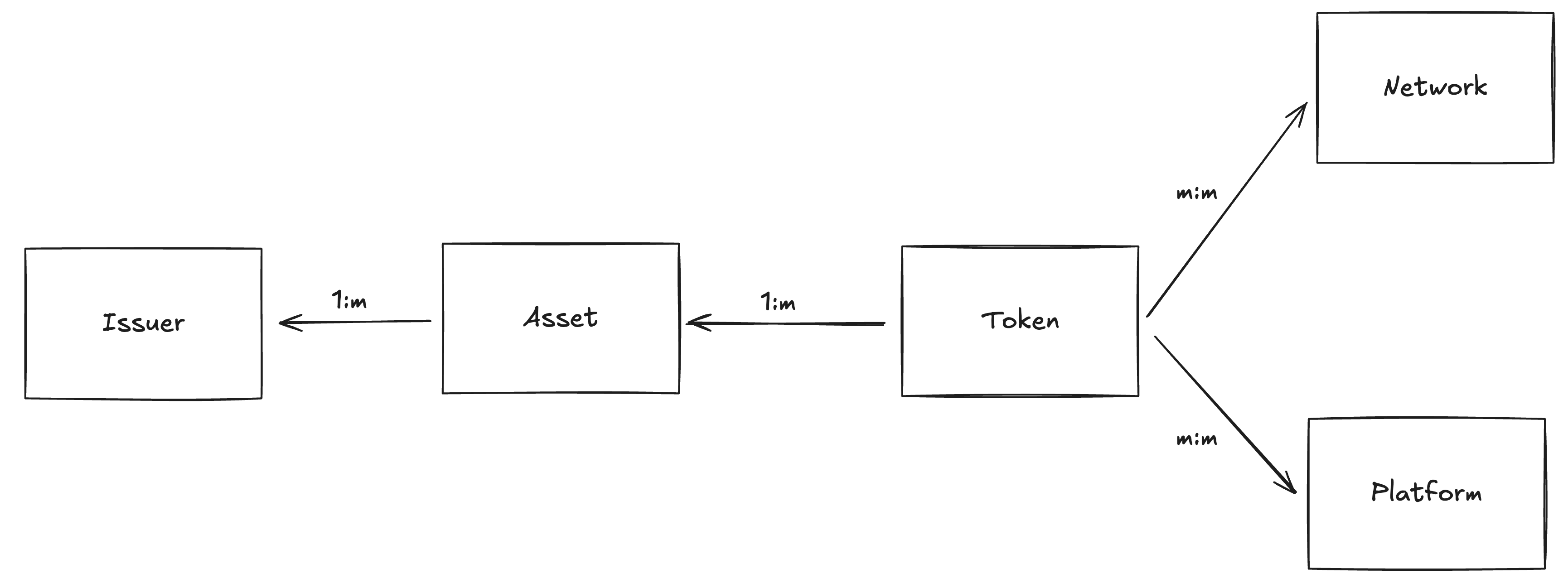
How It Fits Together
Consider BlackRock’s BUIDL fund. In the data model:- BUIDL is an Asset — the tokenized financial product itself
- BlackRock USD Institutional Digital Liquidity Fund is the Issuer — the legal vehicle (an SPV/trust)
- BlackRock Fund Advisors is the Manager — the entity managing the portfolio
- Securitize is the Platform — the entity that deploys tokens on-chain
- Ethereum BUIDL and Polygon BUIDL are Tokens — separate on-chain deployments of the same asset
- Ethereum and Polygon are Networks — the blockchains those tokens live on
- Anchorage Digital is a Service Provider — the crypto custodian for the fund
- Every mint and redemption is a Transaction
Core Entities
Asset
A tokenized financial product. One asset can have multiple tokens across different blockchains and platforms. Examples: USDC, BUIDL, USYC API endpoint:GET /v4/assets | Schema: Asset fields
Example response
Example response
Token
A specific on-chain deployment of an asset on a particular network and platform. This is where blockchain-native data lives — contract addresses, token standards, transfer restrictions. Examples: Ethereum USDC, Polygon BUIDL, Solana USYC API endpoint:GET /v4/tokens | Schema: Token fields
Example response
Example response
Issuer
The entity that legally issues the asset. For a fund, this is the investment vehicle (trust, SPV, etc.), not the sponsor or manager. Examples: Circle, BlackRock USD Institutional Digital Liquidity Fund, Superstate Trust API endpoint:GET /v4/issuers
Example response
Example response
Platform
The entity that deploys tokens on a network. Sometimes the platform is the same as the issuer (e.g., Circle deploys USDC itself). Other times it’s a separate entity (e.g., Securitize deploys BUIDL on behalf of BlackRock). Examples: Circle, Securitize, Centrifuge API endpoint:GET /v4/platforms
In the API, platforms are referenced as
protocol in field names (e.g., protocol_id, protocol_slug) for historical reasons. The terms are interchangeable.Example response
Example response
Network
The blockchain network that a token is deployed on. Networks can have parent-child relationships (e.g., Arbitrum is an L2 on Ethereum). Examples: Ethereum, Polygon, Solana, Arbitrum API endpoint:GET /v4/networks
Example response
Example response
Manager
The entity responsible for managing an RWA fund or portfolio. Not all assets have a manager — stablecoins like USDC typically do not. Examples: BlackRock Fund Advisors, Reental America, Fasanara Capital API endpoint:GET /v4/managers
Example response
Example response
Service Provider
Entities involved in RWA operations. These include custodians, auditors, fund administrators, transfer agents, and other roles in the asset servicing chain. Examples: Anchorage Digital, BitGo, PwC API endpoint:GET /v4/service-providers
Example response
Example response
Transaction
An on-chain event involving an RWA token. Each transaction is classified as a mint (new tokens created), burn (tokens destroyed), or transfer (tokens moved between addresses). API endpoint:GET /v4/transactions
Example response
Example response