
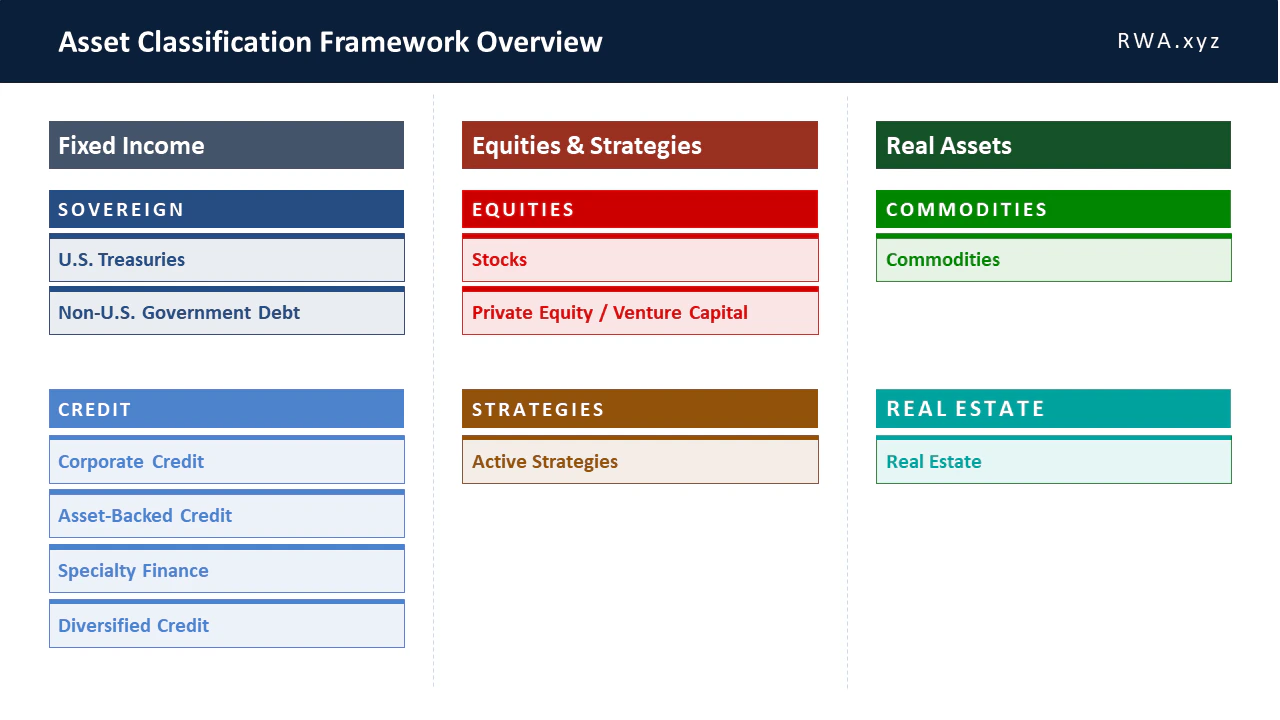
U.S. Treasuries
Exposure to debt obligations of the U.S. federal government. Examples: Short-duration T-bills, long-duration T-bonds, inflation-protected securities, Treasury money market funds, Treasury ETFsNon-US Government Debt
Exposure to debt obligations of non-U.S. sovereign governments and their agencies. Examples: Developed market sovereign bonds, emerging market sovereign bonds, sovereign money market funds, sovereign bond ETFs, supranational bond fundsCredit
Exposure to non-sovereign debt across private or public borrowers.Corporate Credit
Exposure to debt of businesses, where repayment depends primarily on enterprise cash flow and capital structure. Examples: Investment grade corporate bonds, high yield bonds, leveraged loans, CLOs, direct lending funds, corporate bond ETFs, trade finance funds, institutional DeFi lending to corporate counterpartiesAsset-Backed Credit
Exposure to debt backed by specific collateral or receivables, where repayment depends primarily on collateral value, liquidation rights, or asset cash flows rather than enterprise value. Includes consumer loan and receivables exposure. Examples: Mortgage loans, HELOCs, auto loans, personal loan receivables, credit card receivables, student loans, BNPL receivables, consumer ABS, commercial real estate loans, mortgage REITs, real estate debt funds, trade receivables financingSpecialty Finance
Exposure to niche asset- or contract-backed debt requiring specialized underwriting outside standard corporate and asset-backed categories. Examples: Equipment financing, aircraft financing, royalty finance, litigation finance, project finance funds, revenue-based financing vehicles, insurance-linked securities, blockchain infrastructure revenue notesDiversified Credit
Exposure to vehicles investing across multiple credit sub-classes within a single structure. Examples: Tokenized multi-strategy credit funds, diversified private credit vehicles, onchain credit vaults deploying across multiple borrower and collateral typesStocks
Exposure to publicly listed equities. Examples: Large cap equities, small cap equities, sector ETFs, broad market index funds, ADRsPrivate Equity & Venture Capital
Exposure to equity not accessible through public market trading. Examples: Venture capital funds, growth equity funds, leveraged buyout funds, secondaries, pre-IPO shares, non-traded shares of public companiesActive Strategies
Exposure to actively managed mandates pursuing returns through discretionary or systematic strategies across traditional and digital asset markets. Examples: Long/short, global macro, relative value, quantitative/systematic, multi-strategy, DeFi yield, liquidity provision, liquid token strategies, basis/carry, cross-venue arbitrageCommodities
Exposure to raw materials and natural resources through physical ownership, commodity-linked securities, or pooled funds. Examples: Precious metals, energy commodities, agricultural commodities, commodity ETFs, commodity futures fundsReal Estate
Exposure to property values and/or rental income. Examples: Residential property, commercial property, development, land, REITs, real estate ETFsStablecoins
Tokens whose NAV is intended to stay 1:1 with a fiat currency. Tokenization type is Distributed, as stablecoins are intended for payments and settlement. Examples: USD-pegged stablecoins, EUR-pegged stablecoinsFor more detail on the rationale behind this framework, see Introducing Our New Asset Classification Framework.